Friday, August 14, 2015

Nanook of the North (1922)

Country: USA

Released: June 11th, 1922

Genre: Documentary

Directed by: 
Robert J. Flaherty


Produced by: Robert J. Flaherty

Written by: Robert J. Flaherty


As I watched the last few minutes of Nanook of the North I was reminded of the Disney film Snow Dogs starring Cuba Gooding Jr. You remember, right? Its the one about a dentist who finds out he's adopted and travels to Alaska to find his parents only to get roped into the annual dog sledding race. It was the movie that revolutionized the talking animal genre of children's films and led to such other cinematic classics as Kangaroo Jack. I used to love that movie as a kid, I must have watched it at least three or four times.

Man, kids are stupid.

Nanook of the North presents a bit of a quandary when discussing. The film was released and presented to audiences as a documentary but in the subsequent years following its released it's become well known that many of the scenes were staged by the director. Hell, even Nanook's name is fake; the guy was called Allakariallak. So how should one approach this film, as a work of fiction or as a documentary? Personally I would argue that Nuktuk of the South is best tackled as a fictitious representation of inuit life, with actors playing characters, rather than as a piece of cinéma vérité. Still to avoid confusion and to honour the badass protagonist that the movie celebrates I will be referring to Nanook as his real name Allakariallak.

Nunchuck of the East follows Allakariallak and his "family" (his wife in the movie was apparently not actually his wife) as they... well... live. There isn't a plot to speak of. You really just watch these people go through their lives, hunting, building igloos, and just goofing around with their children. That's really it.

Which is not to say that the film is boring by any means. Watching Allakariallak and his fellow inuit hunt seal and just chill (pun very intended) is highly entertaining and the kids are cute. One scene in particularly where one of the squirts tied his tiny sled to a puppy and tried riding around made my heart freakin' melt. Seriously, they're so damn CUTE! The little puppies ride around in their hoods and, and they cuddle with them, and they yawn with their widdle teeth, and sleep in their own tiny igloos and it's bloody adorable! 

As mentioned though everything should be taken with a big ol' grain of salt. I'm not gonna list all the inaccuracies or staged scenes (those can be found here), but its worth mentioning that by this point inuit had been in contact with Western cultures for long enough to have guns and western clothes. Scenes where Allakariallak hunts with spears or where he sees a gramophone for the first time and tries to eat the record are all staged (he knew what a gramophone was).

That being said as many have pointed out there is an authenticity that should be respected. All the animals hunted on screen are genuine kills even if the weapons are obsolete, and many believe that what's shown in the movie is an accurate approximation to how inuit lived before making contact with the West. Plus we shouldn't forget that Flaherty filmed on location. The guy lugged a huge camera to the arctic circle and just started filming shit: the blizzards, the desolate landscape, and the massive icebergs are all genuine, and the dedication shows. You got to respect the man, he really went above and beyond what most would be willing to endure to portray the Inuit culture.

Lastly I suppose it's worth mentioning race since I don't want to break the habit. Some have criticized the film for its use of the word Eskimo and for a racist portrayal of the subject matter. While I'm not going to deny that there is defiantly a "nobel savage" attitude permeating the piece (see: Gramophone scene above) I genuinely think Flaherty had the best intentions when filming the inuit. You really get the sense that he respects Allakariallak and his culture, and that he wants to share his experiences with western audiences. Plus I can't really vilify him for using the term "Eskimo" since that was the accepted vernacular at the time, and complaining about it feels both snobbish and redundant. All in all I guess maybe I'd label it... a respectful, yet clumsy, misstep forward? Let's just say it's not as racist as it could have been, which is good enough.

Overall I liked Nano Nano of the West. Aside from a few staged scenes everything felt... human. Like these were real people carving out the best life they could. While it may not be the best documentary, as psuedo non-fiction its hella interesting, and when I finished watching I had the urge to learn more about the Inuit and their culture which is worth something. Besides even if it isn't one-hundred percent accurate at least it ain't Snow Dogs.

Thursday, August 13, 2015

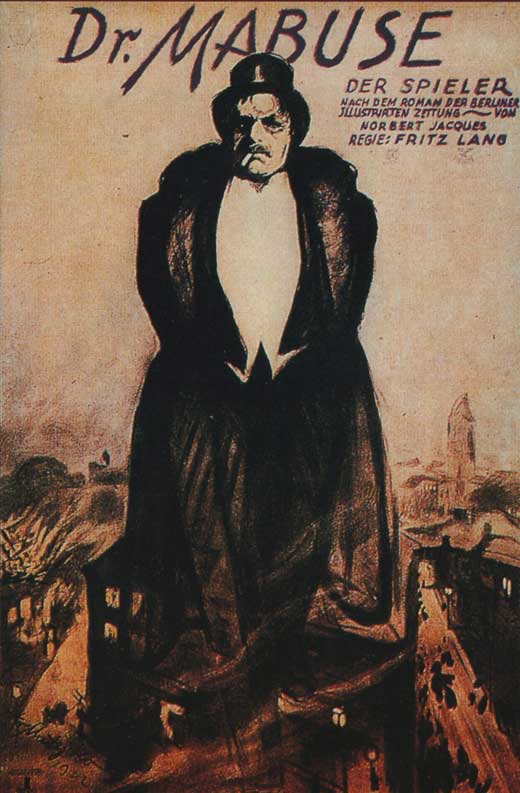
Dr. Mabuse, Der Spieler/Dr. Mabuse, the Gambler (1922)

Country: Germany

Released: May 26th, 1922

Genre: Crime thriller

Directed by: Fritz Lang


Produced by: Erich Pommer

Written by: 
Fritz Lang


Okay let's jump right into this because there's a lot to rant about and I want to be done with this movie already. Dr. Mabuse, Der Spieler follows German state prosecutor Norbert von Wenk (Bernhard Goetzke) as he hunts down criminal "genius" (I cannot find quotation marks big enough for the word "genius") Dr. Mabuse (Rudolf Klein-Rogge), a psychologist and master of disguise with mind control powers that make Jedis look like back alley grifters. I'm not going to go into too much detail because it's a four fucking hour long movie and a lot happens, so just know that after eluding capture thanks to dumb, stupid luck for most of the film, Mabuse's greed and guilt eventually drive him mad and he is apprehended.

I read one description that claimed that Dr. Mabuse was cinema's first super-villain, a description I completely agree with if super-villains regularly ate asbestos and tried to cure their fetal alcohol syndrome with lobotomies. What I'm trying to say is that Dr. Mabuse is a fucking idiot. It's absolutely amazing how stupid this character is, which becomes even more baffling every time the film tries to describe him as this powerful mastermind, controlling society from the shadows like a puppet and holding Germany hostage with his vast intellect, a la Moriarty or the Riddler. At best he's a third-rate Tintin villain and at worst he's Dustin Hoffman from Rain Man minus the charisma or math skills. I cannot stress enough how utterly idiotic this guy is, so let's go over some of these "brilliant" schemes:
  •  Conning a rich, business man out of thousands of Marks at a poker game only to not collect them for some reason (even though he was totally prepared to pay), attracting the authorities to your target and getting jack-shit out of it.
  • Continue following said millionaire, for no apparent reason, leading von Wenk closer to catching you.
  • Killing the millionaire instead of just leaving him alone in an attempt to get the cops off your trail. Great! Well done. You got no money and now your wanted for murder. Plus the detective had other links to you by that point so why murder the poor schmuck in the first place!? The guy didn't even know anything that could incriminate you!
  • Making one of your patients your next target, directly associating yourself with a victim of this long string of crimes the police have been investigating.
  • Kidnapping the wife of said victim, and good friend of von Wenk, because you're horny, drawing more suspicion.
  • Ultimately get caught because instead of running away like you said you would you decided to throw a public magic show like a dumbass for no fucking reason and chose von Wenk as one of your volunteers. Really? Why would you fucking do that!? Is it to hypnotize him into killing himself?  Ignoring the fact that it would be suspicious when the attorney general commits suicide after getting hypnotized at a magic show that's one fucking hell of a gamble especially since he knows your style mind-control. Jesus you might as well have just straight up told him you were the guy he was looking for!
Also what the fuck is up with his god-damned powers? I get that he can hypnotize people with his gaze, I can believe that. Hell, Les Vampires did something similar, it's not an uncommon trope. But when this motherfucker can get a guy to cheat at cards by staring at the back of his head from across a room for half a second you went from mysterious ability to straight-up wizard. Congratulations movie, you have completely shattered my suspension of disbelief. Now everything you do is stupid. Well fucking done. And for God's sakes man, you have the power of mind-control! Why the fuck are you playing card games? Is this really the extent of your genius? Grifting rich people? Do you just want money? Then why didn't you claim any of the cash you cheated the guy out of? What is your motivation!?

"Oh the humanity,"yells the movie. "He's cheating at card games! Oh how helpless the world is to stop this evil matermind!" Are we really supposed to believe that this is what's paralyzing the police department? Some dirty poker games? There's no sense of danger here, the scale of the crimes are so small I couldn't give less of a shit if they stopped him or not. Why not hypnotize a politician or a general or something? I mean fuck it's already established you're some kind of voodoo master who can bend the wills of anyone you choose so why not get a little more ambitious?

The film also really tries to hammer the point across that he's some kind of Übermensch who's transcended contemptible things like empathy or emotion. One particularly laughable moment is when he's talking to his patient's wife about what's important in life.

"There's something more powerful than us...love," she whispers in a daze.

"LOVE? LOVE!? WHAT IS THIS EMOTION!? DOES NOT COMPUTE! DOOOES NOOOT COOOMPUUUTE!" yells Mabuse as sparks fly out of his motherboard. "LOVE ISN'T REAL, ONLY DESIRE. ALL THAT MATTERS IS POWER!" He then leads his horde of Uruk-hai to attack Gondor and retrieve the One Ring I imagine.

The worst part is that I really, really wanted to like this movie. The opening ten minutes were fucking amazing. Without any exposition we follow as Mabuse organizes this Ocean Eleven-type caper to steal secret documents from a moving train. We see one of his henchman strangle the courier and with precisely synchronized timing throw the briefcase out the window into a car. The driver signals to a nearby telephone pole where a lackey is positioned to tap into the wire and call his boss. And where is Mabuse? At home, getting dressed before getting the phone call that everything's gone according to plan, just like a real criminal genius. What an awesome sequence! Everything is so fast-paced and quickly edited that there's this compelling sense of urgency, and we're told everything we need to know about this character without any exposition. The film then cuts to the stock-market where everything is in chaos. Secret trade agreements between Switzerland and Holland have been stolen and now the Swiss are threatening to pull out of the deal, sending Dutch stocks plummeting. Everyone is panicking, sharply dressed brokers are shrieking at one another, desperate to sell their shares. Then suddenly from the madness Mabuse steps onto a platform and calmly announces that he'll buy the worthless stocks. He looks down onto his panicking peers with contempt, knowing full well that he has them in the palm of his hands. He casually checks his watch when suddenly its announced that the treaty has made it to the Swiss consulate, the deal will go through. The stocks shoot up, doubling, tripling, quadrupling in seconds. He nonchalantly announces that he's selling all his recently purchased shares just as the floor closes, and disappears.

Wow! Holy shit, he just manipulated the entire German stock exchange. And that was just the intro! The rest of the movie must be absolutely insane!

Nope. Poker. That's what we get for the next four hours.

Ugh.

I guess what bothers me is that it's not a bad movie. The acting is great and there is the occasionally interesting shot, but it's all used to create something aggressively mediocre, and in a way that's almost worse than if it had just been awful. At the end of the day Mabuse is missing what his type of character needs to be effective and that is a sense of control. Nothing after the stock exchange scene feels like its going according to his plans, and he loses everything that made him compelling. It's just an exhausting movie.


Wednesday, August 12, 2015

Körkarlen/The Phantom Carriage (1921)

Country: Sweden

Released: January 1st, 1921

Genre: Horror, Drama

Directed by: 
Victor Sjöström

Produced by: Charles Magnusson

Written by: 
Victor Sjöström


Damn, this was not an easy movie to watch.

Not because it's content was heavy or graphic, but because it took me, like, half-an-hour to find a full version of the film that wasn't in Swedish. Seriously the first one I found was crap quality and missing a third of the movie. The second version was perfect in almost every way except that I couldn't understand what the hell the inter-titles said, which admittedly would have made for an interesting viewing experience but wasn't ideal. Finally I found a translated version on Internet Archive that was okay save for the terrible music they edited in for some baffling reason. Actually calling it music is putting it kindly, this was one of those crappy 'spooky' soundtracks you find on youtube. You know the ones? They last twelve hours long and you get them by typing in 'creepy music' in the search bar? In any case, it made the movie feel like being in a amateur haunted house some schlub built in his garage for halloween. It created some really tonally dissonant moments which took me out of the experience, so ideally I would suggest learning Swedish if you want to get the absolute most out of Körkarlen.

Fortunately, it wasn't bad enough to spoil the whole movie.

Based on the novel by Selma Lagerlöf, Körkarlen begins in a hospital on New Year's Eve as a kindly Salvation Army nurse named Edith (Selma Lagerlöf) is slowly dying of consumption, a.k.a old school tuberculosis. Feeling her final hour nearing she requests that David Holm (Victor Sjöström), a drunk vagabond who she once helped, be brought to her at once so that she may apologize because she thinks she ruined his life. David however refuses and his friends, offended by his callousness, attempt to force him, knocking him unconscious in the ensuing scuffle. His soul emerges from his body and comes face to face with the Phantom Carriage and its driver, the Grim Reaper, who David recognizes as his recently deceased friend Georges (Tore Svennberg). Georges explains to David that the last person to die every year must take up the mantle of the Reaper for the next year, and that now it was David's turn. What follows is a series of flashbacks through David's life, his decent into alcoholism, the imprisonment of his brother for five years for murder (five years! Really!? Dammit Sweden, it's the 1920s, you're still supposed to be as shitty as the rest of the world), and his wife Anna (Hilda Borgström) taking their children and leaving him. The film ends with David returning to his body and finding redemption with his wife.

Let me just say right off the bat that I really liked this movie, hell I'd almost say I love it. But it's not a movie that's easy to like. It's not like say Dr. Caligari or Le Voyage where the style immediately draw you in. It's very simply shot and there aren't any breathtaking visuals to catch your attention with the notable exception of the special effects used for the Phantom Carriage, which makes it translucent, giving it a spectral feel. What makes this movie great is its characters and their subtle depth. In that sense one really needs to look at the little details this movie offers to truly appreciate the layers of characterization going on, especially in regards to David.

On the surface David is a total twat and given the types of movies I've seen recently I completely expected that to be the full extent of his character, but the more you watch him the more you come to understand his struggle. His infection makes him feel unclean and he holds himself responsible for his brother's decent into alcoholism and ultimate imprisonment. Both of these cause a deep-self loathing that he doesn't quite understand or know how to confront and thus manifests into a bitter hatred of everyone around him. He coughs into people's faces hoping to infect them, asking "why should they be better than [him]?" Yet despite this murderous attitude when offered a chance to be the Grim Reaper and truly kill those he hates he's horrified by the prospect. Similarly when he finds his wife collapsing due to an illness he rushes to help her despite spending most of their marriage abusing her. He spends most of the film cynically hating all those around him yet fundamentally cannot bare to watch them get hurt. This is most prominently displayed at the end, when he's watching his wife ready to poison herself and her children rather ran watch them starve. Despite having earlier attempted to infect them with consumption he begins pleading for their lives, begging for god to punish him and spare them. It's one thing to cough into someone's face but when confronted with death up close he recoils in horror and realizes how terribly he's been led astray.

Probably the best moment in the film comes at the end when his soul returns to his body and he finally decides to fix himself. He finds Anna and prevents her suicide, telling her he's finally changed. Yet this is something she's heard before and instead of taking his word she sneers and tell him she doesn't believe him. And in this moment, after seeing the error of his ways and deciding to change only to have it thrown in his face, after realizing that he's squandered one too many chances and has done irreparable harm does he realize that he's completely alone. That his hatred has isolated him from everyone he's ever cared about. Crushed under the weight of this realization he can't help but weep; weep for his mistakes, for the time he's lost, and for all the pain he's caused. And it's through this outpouring of emotion that Anna recognizes his sincerity and forgives him. It's such a powerfully intimate scene that truly exposes this character's humanity. And that's what these characters feel like: actual human beings with flaws as well as virtues.

God I really like this movie. I mean really, really like this movie. It's one of those movies that the more I think about the more I appreciate. There's so many great scenes to talk about. Like when Anna and David are reunited for the first time. There isn't a single word of dialogue between them, all their emotion is expressed physically: Anna is tentatively hopeful that David has truly changed, but David is conflicted. He doesn't know what to feel and it shows in his disbelieving expression. As they clasp hands you sense the anger under his facade and it becomes instantly clear he hasn't forgiven his wife for leaving, nor has he seen the errors of his ways.

Or the scene where Anna locks him in their kitchen and tries to flee with their kids again. Watching David viciously hack at the kitchen door with an axe while Anna desperately tries to gather her things and leave before he gets through is heart-pumping. She becomes overwhelmed by her illness and collapses and when David rushed towards her brandishing the axe I totally expected him to kill her. Instead though he panics and rushes to get her water. Just a few moments ago he was threatening to murder her but upon seeing her in actual danger all his rage evaporates and his humanity shines through. Everything about that scene is fantastic, the acting, the way its shot, the 'big fuck' you to doors, and the fact that it helps develop the character. At the end of the day that's really what this film  really gets right, every scene helps add depth to the characters and move the plot forward, nothing feels out of place or tacked on.

The movie explores themes of change and redemption but does so in a way that doesn't feel like its shoving it down your throat. The the fact that every year the Grim Reaper changes coupled with the shots of a clock tower ticking to midnight reflect the passage of time and represent change, something that runs parallel with David's growth into maturity. But it's not thrown at you forcefully. It's all subtext that emerges gradually, which ultimately makes it more impactful.

I wish I could analyse this movie in more detail because there's so much to unpack. I haven't even mentioned Edith and her relationship with David or Georges and his growth as the Grim Reaper, but I think I'll leave it here for now. After all there are a lot more movies to get through. Overall great film, give it a look.

Tuesday, August 11, 2015

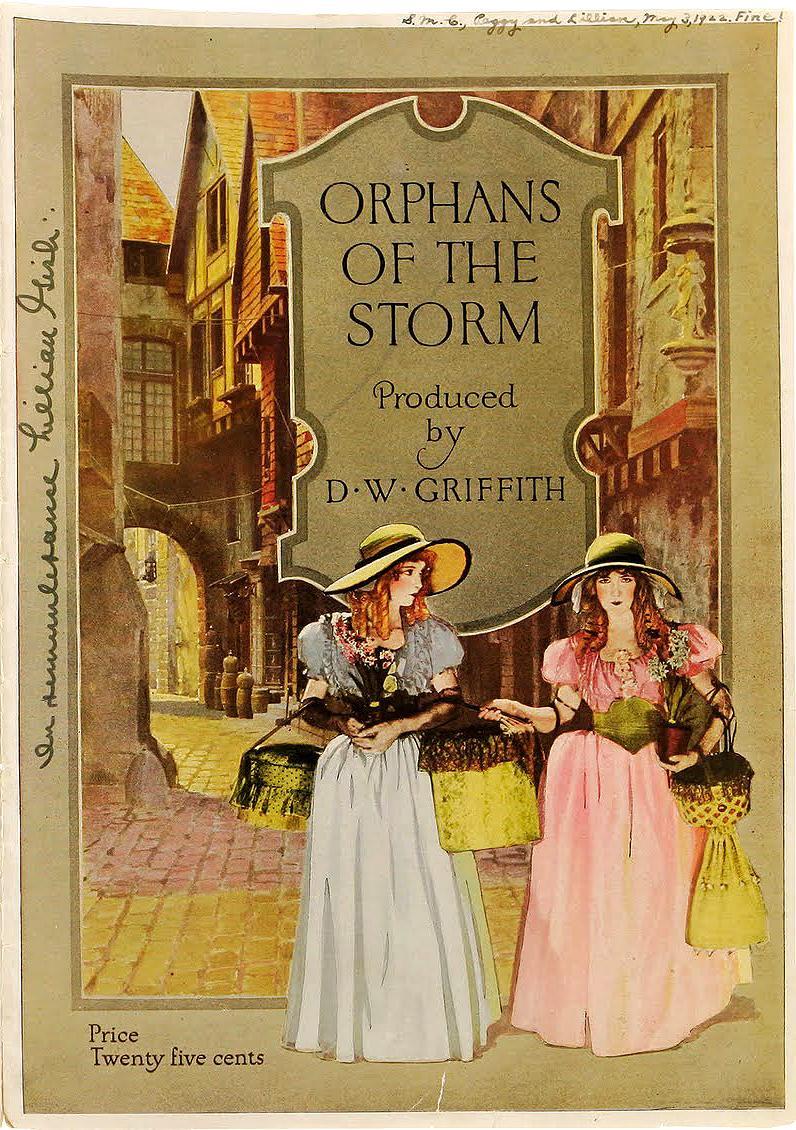
Orphans of the Storm (1921)

Country: USA

Released: December 28, 1921

Genre: Drama, Historical Fiction

Directed by: D.W. Griffith

Produced by: D.W. Griffith

Written by: D.W. Griffith


Griffith, what did history ever do to you? I mean sure it labeled you a horrible racist and hateful bigot, but it also occationally considers you the 'Father of American Film!' Surely there's no need to butcher it like this?

Okay, enough of that. Let's get on with it. It was the best of times, it was the worst of times. I-I mean, it was the best of times, it was... no that's not right, it was the best of times...

Wait what I meant to say was: it was just the worst of times, on the eve of the French Revolution. The film stars Henriette (oh hi again Lillian Gish) and her adopted sister Louise (Dorothy Gish), the blind daughter of an aristocrat who was abandoned at birth and raised by peseants. What's odd about his whole setup is that even though they're supposed to be adopted sisters Griffith still cast two actual sisters to play them, so it's actually weird that they look so similar. Sure they have a lot of chemistry but its just... odd. Was this a marketing thing or did you just forget they weren't supposed to be biological siblings? 

Fuck it let's just move on, there's a lot to cover.

The two take a trip to Paris where Henriette is kidnapped by the Marquis de Parille (Morgan Wallace), a noble who between drinking peasant tears and organizing the annual Hunger Games throws lavish parties in his country house through which to... rape girls apparently. Fortunately Henriette is saved from this fate by her love-interest the honourable Chevalier de Vaudrey, one of the only aristocrats in this movie that isn't a horny, moustache twirling asshole.

Speaking of moustaches, Louise, who is left blind and helpless in the city, is kidnapped herself by Mother Forcharde (Lucille Le Verne), a cruel peasant woman with very distracting lip hair who forces Louise to beg for her and bears a striking resemblance to the character of Madame Thénardier from Les Miserables. While Henriette looks for her lost sister the French revolution happens, oh no! Nobles are killed in the street and bedlam ensues. Just as Henriette is about to be reunited with Louise she and Vaudrey are arrested for being aristocrats and sentenced to death by Robespierre (Sydney Herbert), who is portrayed by the movie as more evil than a child-molesting Hitler. Eventually though they are pardoned by Danton (Monte Blue) and are reunited with Louise, who was freed by her love interest Pierre (Frank Puglia), Mother Frochard's son. The film ends with everyone marrying everyone, Robespierre being killed off-screen, and France becoming a land of peace and fraternity for ever, except for all those other uprisings and wars but who gives a shit about those.

As I've already hinted the film is very Dickensian in its themes and aesthetic, but whereas Dickens had interesting, complex characters Orphans of the Storm just has a bunch of one-dimensional pricks belonging to different factions. And that's really Griffith's style, its not about the characters themselves its about the groups they represent and the struggle between them: blacks/Asians versus whites, Protestants versus Catholics, or in this case rich versus the huddled masses. Each group finds a shallow complexity in having both good and bad characters within their ranks but ultimately the people themselves don't feel very human.

And my god, the history. Did you really need to misrepresent another time period like this? I know most people don't give a rat's ass about movies being historically accurate but being a history aficionado I can't help but feel irked by it. Like why is Robespierre the unrepentant villain? I know he was a cruel man what with his Reign of Terror and all but the way the film tells it you'd think he drank the blood of unbaptized babies or something. It's like Cyrus the Great from Tolerance all over again. Also the French Revolution was a spontaneous uprising not a premeditated event organized by a few intellectuals controlling an unruly mob of savage peasants.

Which brings me to my main point. What it your message here, movie? On the one hand you keep going on about the tyranny of the aristocracy and the suffering of the common people, but on the other hand you portray those common people as a mob of unwashed, dimwitted hicks. Things only get more confusing whenever your inter-titles keeps mentioning the spectre of Bolshevism threatening the world. Oh yeah, this movie has a hate-boner for Bolshevism. That isn't entirely outlandish considering Griffith's politics and the time period (this movie was released at the tail-end of the first Red Scare), and the French Revolution isn't a bad event to draw historical parallels with Bolshevism. But the movie is so indecisive I'm not entirely sure what it's message is. Is it fuck aristocrats but also fuck poor people and we should have a democracy run by the Bourgeoisie? I don't know, and neither does the film.

The only thing it does know is that America has the best political system to ever grace this miserable planet and all countries on Earth would love to just graze the glowing freedom it projects, a message I garnered from a bizarre scene in which Thomas Jefferson and the Marquis de Lafayette show up for half a minute to say as much. They don't appear again, the scene is never mentioned afterwards, and overall it serves no purpose other than to feed into American jingoism. 

One quick side note: Fuck Jefferson! Where my fellow Hamiltonians at?

As always the cinematography and staging are all amazing, but what else do you expect from Griffith? The battle scenes are great, the costumes are beautiful, and the sets really transport you to the time period. But to be honest it all has a kind of 'been there, done that feel' that I couldn't shake while watching it. After the grandiosity of Babylon there really isn't much wow to naturalistic cinema anymore, or at least the way Griffith does it. I completely zoned out through some of the film's epic set pieces and found myself wishing for the abstract simplicity of German expressionism, a phrase so pretentious I can feel the elbow patches forming on my jacket.

But because this is Griffith's last film on the list I can't help but feel a bit melancholic. I mean, he has been a huge part this blog. So let me take a final moment to address him directly.

Look Griffith, I don't like you and you don't like me... mostly because you're dead but that's beside the point. You are one of the most influential and hated directors in all of history. The techniques you employed were revolutionary, and the stories you wove were regressive and ignorant. Your filmmaking influenced a whole generation of directors and kickstarted the golden age of cinema, and your politics ignited riots across the country. Your films were great spectacles to behold, and often bigoted to their core. For better or for worse you are considered by many to be the father of American cinema. Sometimes I loved your movies and sometimes I hated them. Sometimes they filled me joy and sometimes they completely enraged me. 

But no matter how I felt about them at the end of the day you always gave me something to write about, and that's got to count for something.

Monday, August 10, 2015

Within Our Gates (1920)

Country: USA

Released: January 12, 1920

Genre: Drama

Directed by: Oscar Micheaux

Produced by: Oscar Micheaux

Written by: Oscar Micheaux


Within Our Gates follows Sylvia Landry (Evelyn Preer), a young black woman from the south who travels north to visit her cousin Alma (Flo Clements) and fiancee Conrad (James D. Ruffin). However Alma has desires for Conrad and accuses Sylvia of infidelity, convincing Conrad to leave her. But then there's a black school Sylvia works at that's gonna close down unless she raises $5,000. But how will she get the money in time!? By getting run over by a wealthy philanthropist of course! Who agrees to donate $50,000 dollars to the school. Wait, because then there's also this gambler who... uh cheated I guess. But that's not important, what's important is the school! Oh that got saved, okay, um, here's a flashback about Sylvia's past that doesn't have much to do with anything but shows her troubled childhood. Wait, did the gambler just kill a guy? What the fuck is happening!?

So if it isn't apparent already I don't really know what happens in this movie. Even the wikipedia page sounds confused. To be fair that isn't entirely the director's fault as the film hasn't aged intact and major segments are missing, but that doesn't make the parts that did survive any less slow; which is to say that if I could not have been more mind numbingly bored if had been two hours of paint drying. Seriously, if this film ever makes a come back ambien sales will plummet.

I am absolutely amazed with some of the praise this film gets from contemporary film critics. Granted it ain't easy to follow The Cabinet of Dr. Caligari (a film so ball-numbingly good I'm tempted to just write about that some more instead) but nothing about Within Our Gates is particularly praise-worthy. The cinematography is flat and uninteresting, the story is schizophrenic, the themes are as subtle as D.W Griffith (or a kick to the balls), and almost every single character looks the same. And before you go crying racism I'll have you know that the white characters were just as interchangeable as the black ones thank you very much.

The one notable thing about the film is it's anti-racist themes. And I mean real, 100% anti-rasicm, not 'let's make our virtuous asian protagonist be played by a squinting white guy' anti-racism. Griffith, take notes: every black character is played by a black actor and the ultimate message of 'black people are human beings (paraphrasing) while cheesy and ham-fisted by today's standards is probably what 1920s America needed. Basically my point is that 1920s America needed a kick to the balls.

The only time I was ever even remotely invested was when they shifted to the self-hating minister who preached black subservience under the guise of moral purity in exchange for money from white backers. At least I think that's what was happening, this segment is so brief and unessential to the plot its not even referenced on the wikipedia page. In any case, watching him struggle with his guilt at selling out his dignity is fascinating and would have made for an interesting film all on its own. Instead its just a bizarre digression from the main plot.

I don't know how much of the original Within Our Gates is missing but I don't want to write off Micheaux so soon. I hope he has at least one more film on this list, because this was definitely not the best movie to judge him by. 

At least tomorrow I've got another Griffith film to look forward to, if nothing else he's entertaining I'll give him that

Sunday, August 9, 2015

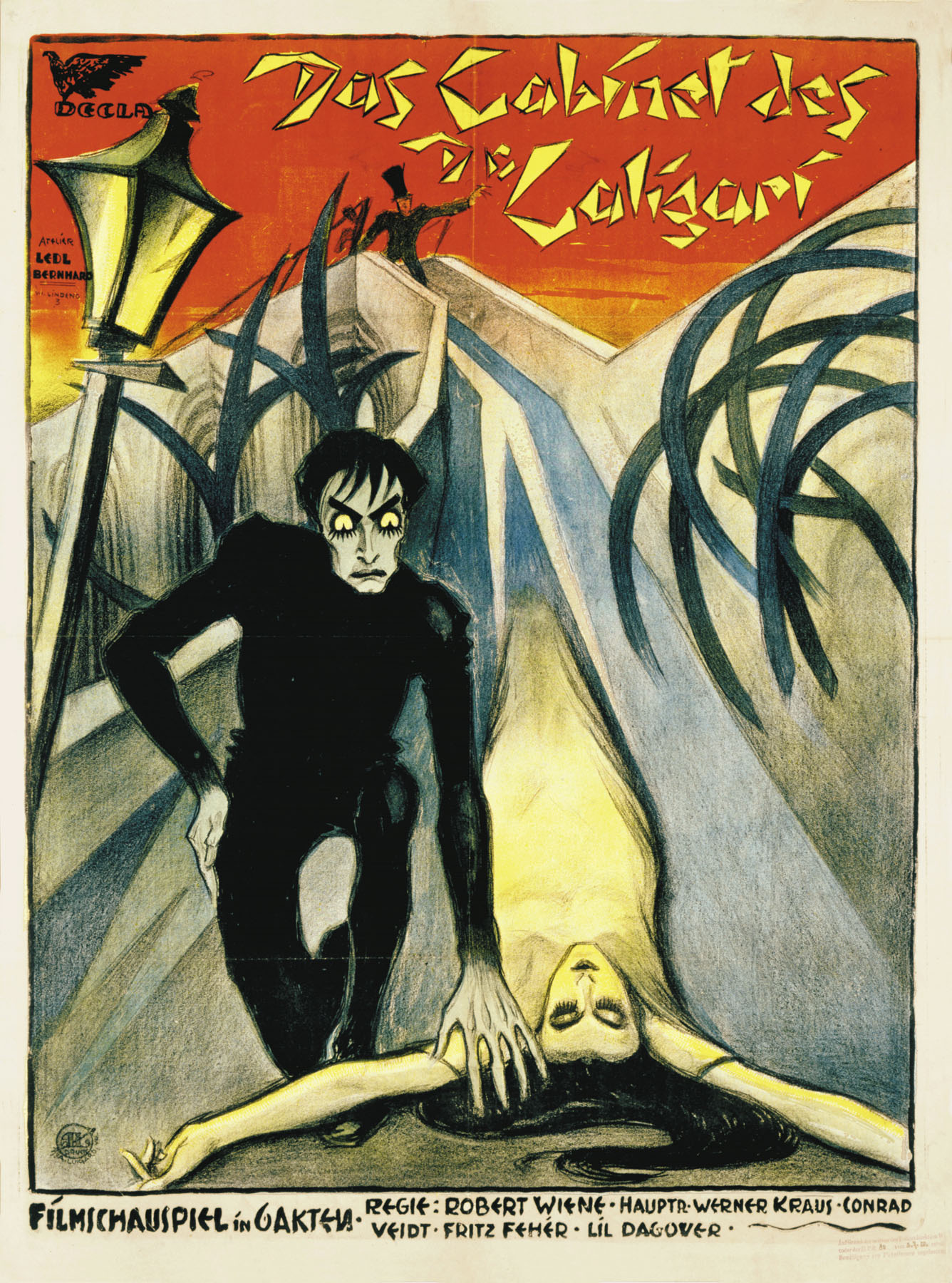
Das Cabinet Des Dr. Caligari/The Cabinet of Dr. Caligari (1920)

Country: Germany

Released: February 26, 1920

Genre: Horror

Directed by: Robert Weine

Produced by: Rudolf Meinert

Written by: Hans Janowitz


You know, I could start this off with a joke about Europeans and avant garde expressionist cinema, but that's been done so much it's practically hack. So I'll just say this:

The Germans don't fuck around.

This is it. One of the big ones. One of the films that almost everyone's heard even if few know much about. One of those films that is taught in every film class. One of those movies that completely changed the game.

This is The Cabinet of Dr. Caligari.

Regarded as the first "true" horror movie The Cabinet of Dr. Caligari is mostly told through flashback, as our protagonist Francis (Friedrich Freher) recounts his encounter with the famed Doctor Caligari (Werner Krauß), a Danny DeVito-eque man who runs a carnival stand where he exhibits the creepy somnambulant Cesare (Conrad Veidt), who supposedly never wakes except when goaded by his master. When a series of murders start ravaging the town Francis discovers that Caligari, who turns out to be a local insane asylum director, is manipulating Cesare to kill. Francis rounds up the local police to arrest the Doctor only for it to be revealed that he was a delusional madman interred in Calagari's asylum the whole time. What a twist!

Damn, where to even start? Let me just say right off the bat that this is one of the most unique-looking movies I've ever seen. Every shot positively drips with atmosphere as characters traverse the twisted urban landscape of the village in a visual style reminiscent of Tim Burton's early work; in fact I wouldn't be surprised if Dr. Caligari was a direct influence on The Nightmare Before Christmas or Beetlejuice. The film is a cubist painting come to life filtered through a gothic lens, and every single moment of it is gorgeously haunting. Even the characters are all sporting dark makeup to accentuate ghoulish features, emphasizing the nightmare world they're trapped in. Seriously I could spend an entire post, hell dozens of posts, just talking about how this movie looks, and the surreal dreamscape is actually complemented by the technology's limitations, as the black-and-white colouring accents the shadows and lighting. Hell, even the inter-titles use a customized font that twist the letters into eerie, jagged shapes.

This is truly a post-war film. Long gone is the whimsy of Méliès, now everything is seeped in the bleak cynicism following the apocalyptic destruction of the Great War. The film itself could actually be viewed as a critique of the war and the German leadership: Calagari is a clear representation of the German government, who manipulates the sleepy, unassuming German people, here symbolized by Cesare, into violence. In fact it is worth noting that Hans Janowitz and Carl Mayer, the film's writers, were both pacifists by the time they developed the film and had suffered considerably during the war, so this interpretation is generally regarded as fact.

The ending unfortunately undermines the anti-war critique by having Francis be revealed as insane, and according to Janowitz they were forced to modify the original ending and accommodate this twist. Despite its thematic dissonance however I actually enjoyed the twist, even though I saw it coming (Seinfeld Effect and all that). I thought it fit well within the established setting and was extremely chilling.

Damn though this movie really is beautiful looking. The first murder scene in particular, in which Francis' best friend Alan (Hans Heinrich von Twardowski) is stabbed by Cesare is notably well rendered as the camera pans back and focuses solely on the two characters' shadows as they struggle for the knife.

The music was also fantastic. Now I'm not sure if the version I watched had some approximation to Giuseppe Becce's original score, probably not, but regardless to anyone considering watching Dr. Calagari I recommend finding the version restored by the Bundesarchiv-Filmarchiv, the organization charged with maintaining and storing German films. The music they used is spooky as hell and unnerved me to my core, which is exactly what you want from a horror movie.

It's difficult to articulate what makes Dr. Caligari such seminal film since most greatness lies in its visuals, which feels redundant to try to describe. Long-story short The Cabinet of Dr. Calagari is easily the best film I've seen so far and without a doubt gets my recommendation. If nothing else look up some stills from the set just to get a sense of the aesthetic they've got going on, it absolutely deserves a look.


Saturday, August 8, 2015

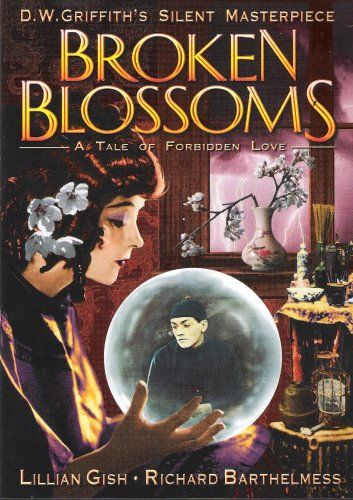
Broken Blossoms or The Yellow Man and the Girl (1919)

Country: USA

Released: May 13th, 1919

Genre: Drama, Romance


Directed by: D.W. Griffith

Produced by: 
D.W. Griffith

Written by: 
Thomas Burke


Aww you were doing so well, Griffith. Why'd you gotta blow it by throwing yellow-face at us?

All right let's keep this short: Broken Blossoms or The Yellow Man and the Girl follows devout Chinese buddhist and pacifist Cheng Huan, played by white actor Rich Barthelmess, as he travels to America to spread his message of peace only to be crushed by the cruel realities of life in the new world. Shortly after taking up opium to ease his depression he becomes infatuated with the young Lucy Burrows (Lillian Gish), an innocent girl living in fear of her abusive father Battling Burrows (Donald Crisp), a savage boxer who makes Bluto from Popeye look like Bob Ross. He beats his daughter, drinks like a sailor, and hates foreigners. I can only assume he also denies the Holocaust and thinks that 9/11 was an inside job.
Basically he's a bad-guy and upon discovering her daughter's relationship with Cheng beats her to death. In his grief Cheng forsakes his peaceful ways and succumbs to rage, killing Battling. The film ends with Cheng committing suicide over Lucy's body just as the police prepare to arrest him for the murders.

Woah, fuck me movie that's pretty twisted. I've gotta say I did not see that coming and It's pretty ballsy to take it in such dark direction.

Unfortunately that's really the only notable thing about Broken Blossoms. The acting is alright; you can always expect a good performance from Lillian Gish, but the characters are fairly one dimensional. Lucy is your typical damsel in distress and Battering is you're average Holocaust denying, daughter beating villain. I guess Cheng is fairly interested what with his descent into violence and all, but he really isn't given as much screen time as the other two so it's not as impactful as it could have been.

And that brings me to the main point. The film tries to convey this anti-xenophobic message of tolerance by making Cheng the gentle hero and making an interracial relationship the main plot. But all of that is undercut by having a white actor in yellow-face play Cheng, and I gotta say Barthelmess looks about as asian as Mikey Rooney (and thank god he never played an asian character, amiright?). Barthelmess spends the whole movie squinting in a laughable attempt to look more asian, but he just comes across as confused or stoned out of his mind.
Dammit, Griffith! It's clear you were trying to make an anti-racist movie, for god sakes you try to make one of the daughter killing physo's most despicable traits his xenophobia. You couldn't have at least tried to get an asian actor for the lead? Hell the first ten minutes of the movie is chalked full of them, why didn't you just pluck one of them for the role? Cheng just comes across as a sleepy white guy at best and an offensive caricature at worst. He doesn't feel like a genuine person, which ultimately blunts the tragedy of his demise.

I don't know, I suppose there is something to be said about having an 'asian' lead at the height of anti-asian hysteria in the U.S (back when the phrase 'Yellow Peril' was used unironically to scare white folk), but Barthelemess' performance is so silly and laughable it can't help but come across as a bit of a misfire, and the film suffers for it. Still though, it is a huge damn improvement over Gus from Birth of a Nation.

There really isn't anything else to say about the film. After the grandiose walls of Babylon in Intolerance, Broken Blossoms feels small and... well, crummy by comparison. Film critics laud the closet scene in which Gish's Lucy is cornered by Battling as a instance of masterful filmmaking, but I didn't find it all that special. Sure Gish's acting is good but it didn't grip me as much the St. Bartholomew Day Massacre scene from Intolerance.

Overall I don't see what in this film warrants a spot on the list. The ending is a nice surprise and I imagine that in the context of the time period it was a great step forward in combating racial prejudice, which is admirable. But for a list of movies you MUST see before you die Broken Blossoms comes across as really... average.

Definitely one you can skip.