Sunday, September 13, 2015

The Phantom of the Opera (1925)

Country: USA

Released: November 25th, 1925

Genre: Horror


Directed by: Rupert Julian


Produced by: Carl Laammele
Written by: Elliot J. Clawson (and like ten other people)


Damn that's an ugly poster. I don't know who designed it but whoever it was should have been laughed out of the conference room the moment he presented it. Ignoring the mishmash of crap going on above the writing, in a movie full of iconic visuals why pick one of the more forgettable scenes of the film? Did you really think the "Phantom goes for a snorkel" sequence was going to be the defining moment of your movie? 

Full disclosure before we go any further I have never seen a Phantom of the Opera movie. I've heard that they're all pretty bad in their own way, and I never had any interest in watching them. My attitude was that if I was ever going to subject myself to such a kitsch story, and make no mistake it don't get more kitsch than Phantom of the freaken' Opera, I was going to at least watch it on stage. Alas, Schneider in all his divine wisdom has deemed it necessary that I watch it in movie form, praise be his name. And so, here we are.

It's weird to think that when this version of The Phantom of the Opera was filmed the book it was based on had only been out for fifteen years. Today thanks to countless film adaptations and theater production it feels as if it was a story written centuries ago. The plot, as if I should even bother, is of course about the titular Phantom, a crazed, disfigured lunatic named Erik (Lon Chaney) who prowls the Paris opera, terrorizing those within. He sets his eyes on the understudy of the opera's lead, Christine Daae (Mary Philbin). After manipulating the opera to give Christine the lead role he invites her to his lair where he reveals that he is in love with her. Christine is horrified by his appearance and lies to the Phantom to escape and return to her love, Raoul de Chagney (Norman Kerry). Betrayed and enraged, the Phantom kidnaps Christine leading to a chase through the Paris catacombs as Raoul and inspector Ledoux (Arthur Edmund Carewe), a police officer who was hunting the Phantom, try to rescue her. The film ends with Raoul saving Christine and a mob killing the Phantom.

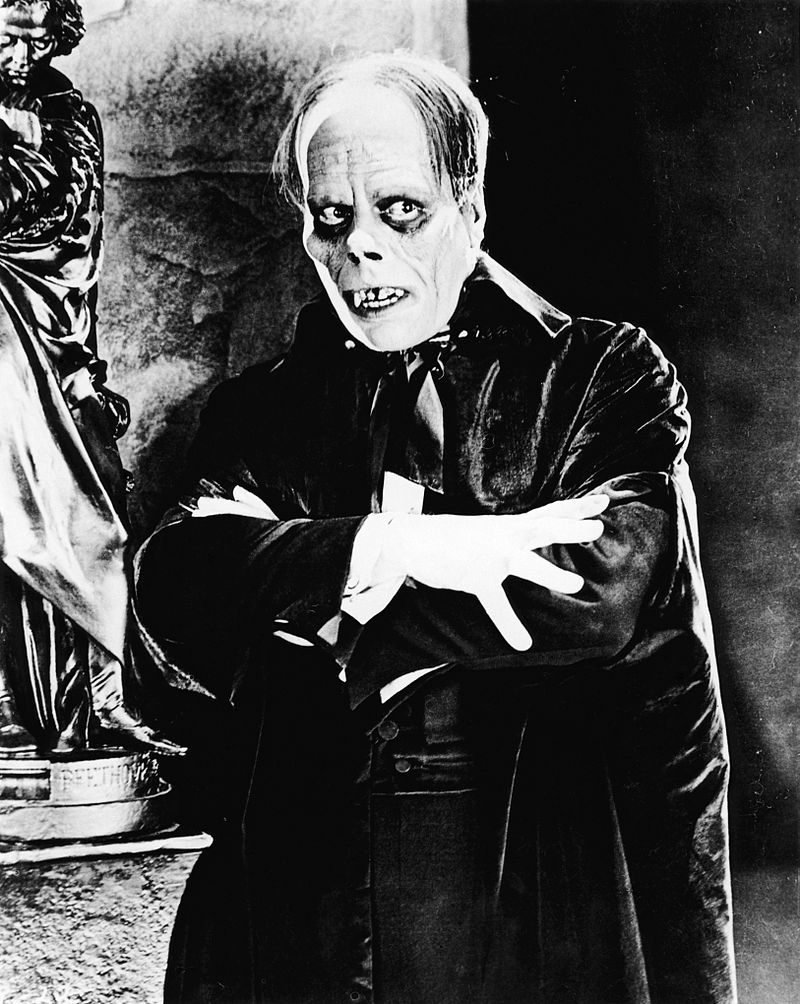
So as many of you may have noticed this version of Phantom differs from other versions in that it lacks any meaningful love story between Erik and Christine, instead opting for a full blown horror story. Even I, having never even seen the other adaptations, was expecting a tragic or melodramatic (i.e. kitsch) romance between the tragic figure of Erik and the lovely Belle, I-I mean...uh... beauty, er, no wait, Christine. Yes that's it. Raoul was supposed to be a one dimensional Gastone (you know, the douchebag?) and Erik was supposed to look like a Chip n Dale's model with some gunk on his face to make him "ugly." Instead we get a Gothic monster movie, which may sound surprising but people forget that originally the Phantom was for a long time considered one of staples of the Universal Studios monster pantheon, up there with the likes of Dracula and Frankenstein. Everything about the movie is in service of the horror: the catacombs in which the film takes place drip with old-school horror atmosphere, the use of shadows to display characters, such as the Phantom himself and some of his victims, contribute to the sense of mystery and darkness that inherently surrounds the character. Even the makeup differs from later iterations in that it goes for a fully deformed look rather than the aforementioned "hot guy with an overgrown boil" approach of later adaptation that better suited the love-story. The makeup is as good as everyone says by the way. It's the most iconic part of the film, and it's not hard to see why: the Phantom looks absolutely ghoulish with his sunken eyes and upturned nose. Just look at him!


He looks like Emperor Palpatine from Star Wars, Deadpool, and one of the California Raisins got freaky at a swinger's key party.

Fun fact: Chaney himself designed his makeup for Monster Mash up there, something that would become a staple of his acting career.

As nice as the makeup is though the character of the Phantom feels too freakish, if that makes any sense. He's not all that sympathetic. There are a few moments when it feels like his monstrous persona looks like it's about to crack but it never comes to fruition. Any chance of redemption is completely lost when it's revealed he's a criminal escaped from an insane asylum, thus negating a lot of his motivation and relegating him to the archetypal "madman". What the other versions had over this one is that their Phantom's were tortured souls, tragic figures cast out by society and seeking redemption via love. Here all his rants about being redeemed by love feel like the delusions of a psychopath, not to mention that the movie doesn't bother establishing his love of opera or music which I assumed was a staple of the character. Supposedly there were plans on using the original ending from the books where he dies of a broken heart at the foot of his organ, but apparently this didn't sit well with test audiences so naturally they had the Phantom beaten to death by a mob. 

Smooth.

Still all this is not to say that the Phantom has no depth whatsoever, it's just not the kind that probably keeps in the spirit of the book. The Phantom is a fascinating lunatic, and it's interesting to watch this character get torn apart by his own psychosis. He doesn't feel like a zombie or slasher villain, his motivation goes beyond just kill everyone, he genuinely believes his mad plan will somehow 'save him,' which I suppose is tragic in a way. One of the moments that best illustrates this is when Erik plays "Don Juan" by Strauss. There's a lot of symbolism going on in that simple moment. Don Juan is the young, handsome protagonist of an old Spanish novel, "El burlador de Sevilla y convidado de piedra," and follows him as he manipulates women into sleeping with him. One could argue that the Phantom hopes to style himself as Don Juan, this handsome womanizer. However what he doesn't realize is that the point of the story is that Don Juan is really a monster who uses his charm to get his way and make other's suffer, ultimately meeting his demise at the hands of one of his victims. The parallels between the two stories are evident and there is a lot more room to interpretation that I've barely covered but I'll keep it at that.

The art direction is pretty gorgeous as well, particularly a masquerade scene which was painstakingly coloured in by hand. And holy crap what colours! If i didn't know any better I would have thought I was watching technicolor. Everything in that scene really pops, particularly the Phantom in his bright red robe which, along with his skull mask, feels instantly memorable. Lastly of course there is the music. The problem with music before the advent of sound is that it's difficult to tell if the music you're listening too is the original soundtrack or not. You see, what directors used to do is record the music separately from the film and then send both the movie and the soundtrack to cinemas to play simultaneously. In many cases these soundtracks didn't survive the passage of time and we only have modern scores to accompany them. Fortunately for us though the original music for Phantom of the Opera survived and it is great. The vocals for the opera scenes are particular noteworthy and edited in such a way as to synch with the performers on stage. While most of the time it's not a perfect synchronization and ends up looking bad, on occasion it lines up just right and feels like I'm watching a film in sound, especially when one of the singers transitions from holding a note into a shriek as a chandelier falls into the audience. It's a great sequence and made me jump in my seat.

The Phantom of the Opera is a good movie. Despite one or two missteps such as the overly evil villain and a clumsy ending, it comes together solidly. I wouldn't call it a favourite, but for fans of old school horror there is definitely a lot to enjoy.

Thursday, September 10, 2015

The Eagle (1925)

Country: USA

Released: November 8th, 1925

Genre: Drama, Romance


Directed by: Clarence Brown


Produced by: John W. Cosidine Jr.

Written by: Hans Kraly


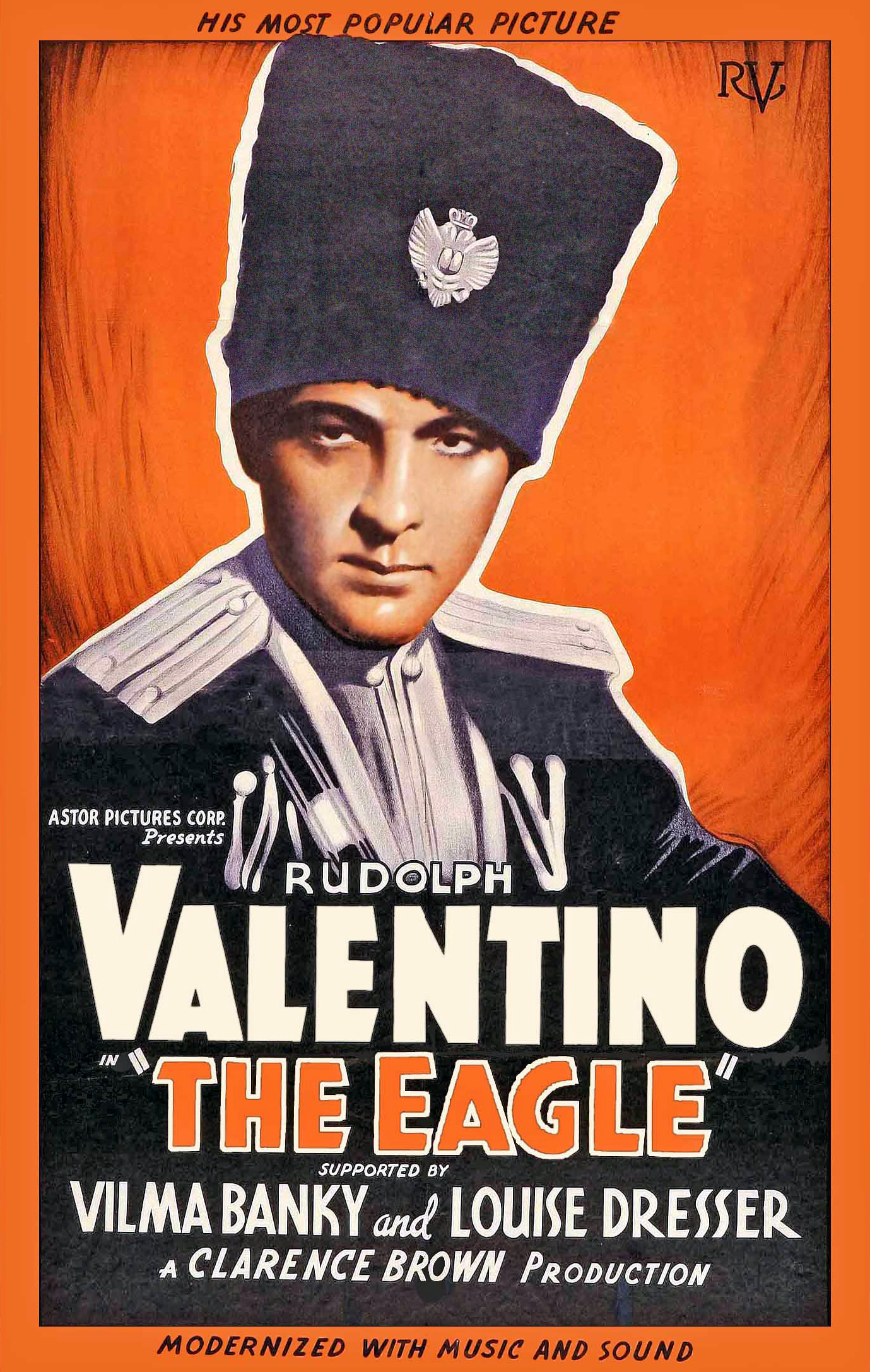
See that poster right up there? You see how the name "Valentino" is the biggest word on that poster, even bigger than the movie title itself? That's because Rudolph Valentino was kind of a big deal. For the uninitiated, Rudolph, full name Rodolfo Alfonso Raffaello Pierre Filibert Guglielmi di Valentina d'Antonguolla, was Hollywood's first sex symbol. Just to be clear though, when I say he was a sex symbol I mean that as far as the public was concerned he made Marilyn Monroe look like Susan Boyle. Hyperbole aside though the man was a legend. He pretty much cemented the whole "Latin Lover" trope in popular culture and if there was ever a guy who best embodied the phrase "women wanted him, men wanted to be him" it was Valentino, who was reported to receive hundreds of letters a day from ravenous female fans. The man is credited with starting the tango craze in America after he danced it in one of his movies. The guy was so sexy in fact, one quote from one of his fans of the time was described him as "triumphantly seductive. Puts the love-making of the average husband or sweetheart into discard as tame, flat, and unimpassioned."

Hot damn, that sounds like a hell of a lover.

I only wish his movies were just as good as his looks.

The Eagle is about a Russian Cossack named Vladimir Dubrovsky (Valentino) who's love for Russia is only second to love of stupid hats. He is approached by the Czarina Catherine the Second (Louisse Dresser), a thirsty MILF who's looking for some sweet, sweet Cossack action. Vladimir refuses her advances and she declares him a traitor, putting a bounty on his head and forcing him to flee to his old village. Once there he finds out that his father, a nameless putz who's sole purpose in life was to die for the plot, has died for the plot. Vladimir swears revenge on the man who killed him, Kyrilla Troekouroff (James A. Marcus). He dons a mask and the name "Black Eagle" in a sort of Russian mashup of Zorro and Robin Hood. After some good ol' banditry he infiltrates his enemy's palace by impersonating a French tutor. There he falls in love with Kryllia's daughter, the lovely Mascha Troekouroff (Vilma Bánky). He is eventually found out, brought to the Czarina, and sent to be executed. The Czarina has a change of heart though and gives him a new French identity, letting him and his new wife Mascha (oh right, they get married the night before the execution) to escape to Paris where they presumably live happily ever after. Or maybe they're eaten by wolves on the way there, I don't know I didn't write the screenplay.

If I had to pick one word to describe The Eagle is would probably be "generic," followed very closely by "forgettable." Maybe it's presumptuous of me to say so but I'm starting to notice a bit of a pattern with many of these movies: LOVE STORY(!) in an exotic location or historical time period pretty much sums them all up. Oh, and don't forget that it helps if at least one of the love interests is rich. Say what you will about Stachka (it was too abstract, too preachy, too lenient on capitalist pigs) but at least it was something original. I don't think I've ever seen a cow get slaughtered on screen before and, while horrifying, at least it wasn't another fucking romantic comedy starring Jennifer Aniston or whatever. Look my point is that The Eagle wasn't all that great. I assumed whatever print survived didn't survive intact. The film looks shockingly blurry and I had trouble making out some scenes, especially when compared to the crisp presentation of Stachka or The Thief of Baghdad. Plus it's just plain boring. It's a story I've seen told a million times before. Maybe not in exactly the same way but twenty minutes in if I'm already muttering to myself "he get's the girl" and that's the only real tension you have then you might want to rethink your story. One could argue that it's about the journey not the destination that makes the movie good, and that's certainly why Thief of Baghdad worked for me despite having an equally predictable plot. But Thief also had a gorgeous set, fun music, breathtaking practical effects, and above all else Douglas Fairbanks, who is amazingly charismatic. Eagle has none of that: it's music is dull, although it's hard to tell since this is likely not its original soundtrack, it's sets are uninspiring vacillating between a forest and a big house, it has no real effects to speak of save for basic stunt work in a few horse scenes, and lastly while Valentino sure is nice to stare at he often feels like nothing more than a pretty face. He isn't bad by any means but he rarely surpasses adequacy. 

Even the genre feels plain. It's a film peppered with comedic moments but it falls short of being labeled a "comedy." It's a serious movie with comedic bits, not a comedy with serious bits. This normally would lend itself well to a light, low-stakes drama but in the case of Eagle just gives the sense that the movie didn't want to commit to either tone. That being said what few funny scenes there are are pretty damn enjoyable. I especially liked the seductive Czarina and the running gag that she keeps offering her officers generaliships as she eyes them up hungrily. Also a scene where Mascha finds Vladimir strangling her father and rushes to stop him only to be told that he was merely massaging his headache away is pretty great. Vladamir then continues to seemingly beat the shit out of Kyrilla much to his joy. The problem though is that as fun as these moments are they only serve to emphasize how much I wish there were more of them. The movie probably would have been best served if it went full on comedy, especially if it focused more on the Czarina who feels criminally underused. Sure there's the occasional nifty camera trick but at this point I'm running out of things to say. Ultimately: a painfully average piece that I'm sure I'll forget about in a week.


Monday, September 7, 2015

Stachka/Strike (1925)

Country: Soviet Union

Released: April 28th, 1925

Genre: Drama, Propaganda


Directed by: Sergei Eisenstein


Produced by: Boris Mikhin

Written by: Grigori Aleksandrov


And I thought D.W Griffith had trouble with subtlety, yeesh. 

Stachka is a Soviet propaganda film designed to glorify the proletariat and demonize the bourgeois, and thank god! All these none-Bolshevik films was starting to make me forget the glory of Communism. Remember kids, there is no such thing as the ethical exploitation of labour under a capitalist system. "Capital" as the fat cats of Wall Street like to call it is nothing more than the toil of the worker. Adam Smith was mass murderer and a monster on the level of that fascist pig Hitler. Now that we've got that out of the way onto the review.

Directed by... Eraserhead apparently, Stachka chronicles the story of a strike, the rise of workers, their discrimination by their superiors, and their eventual slaughter at the hands of law enforcement.

And that's it. No really, that's it, that's the whole plot, a strike. There is no main character, no protagonist, no consistent villain beyond a series of assholes, not even any real side characters either. Sure there's the occasional character that crops up more then once but they're never given any focus beyond being used as tools to create emotional resonance for the overall plot. I'm pretty sure only one or two characters even has a name, and they're nicknames to boot. I suppose the point is that the workers themselves are the hero, reinforcing the notion that they're all equal, but without a protagonist for the audience to project on the movie quickly stops being compelling. We never even see the workers do anything particularly virtuous or good, we're expected to believe that they're the good guys just because they're the proletariat. It makes sense of course considering this was just after the end of the Russian Civil War when Bolsheviks were cementing their political power and people where expected to take this at face value, but to modern audiences it's not engaging. In fact the whole Communist-Capitalist struggle in and of itself feels dated to people my age. There's a notable rift between my generation and that of my parents, who were in their twenties when the Berlin wall fell. I'm always bemused whenever I hear conservative American politicians use "Communism" or "Socialism" as grave insult, or whenever a Latin American politician rambles about the "Class Struggle." It really feels like something from a bygone era, something before my time that I can't really relate to. 

This disconnect is especially highlighted by Stachka. The bad capitalists look like they all jumped out of a political cartoon, wearing top-hats and monocles, smoking cigars, and stuffing food into their fat, gluttonous faces as they discuss how best to crush those pesky workers. If there was any sound in the movie I'd bet my life savings I would've heard at a "harumph" or two, and I was shocked that they weren't introduced with a panning shot over a skull-shaped base protruding from a volcano. The metaphors are just as subtle, with two particularly erroneous moments including the capitalists squeezing a lemon as they discuss crushing the workers, saying things like "you've got to squeeze each drop," and the final scene where the killing of the striking workers by Tsarist soldiers in intercut with graphic footage of butchers slaughtering a cow.

"BOY, I WONDER WHAT THE MOVIE IS TRYING TO SAY!"

The last shot is literally the words "Remember" as a pair of creepy, Big Brother eyes stare at you. It all feels so preachy. And yes, I know propaganda isn't supposed to be subtle but that doesn't make this movie any more enjoyable. Stallone also did propaganda with Rocky IV and Rambo III and those were at least fun or had a plot. This just feels tedious. Some of the visuals are thematically well done like cutting back between the riotous workers and the despondent factory owner as he marches through his empty, ransacked offices, but it doesn't do enough to make up for the lacklustre plot. Really the only exceptional moments come when the cinematography is allowed to go wild. The first ten minutes illustrate this especially well with great stylistic choices like having conspiring workers only visible through their shadowy silhouette or filming the factory against the reflection of a mud puddle as workers march through. These shots are all compounded by a fast paced editing style that permeates the whole film. But while this breakneck editing is effective early on it eventually becomes tiresome and makes the movie difficult to watch. I went to the kitchen for two minutes while the film was still playing and when I came back I was completely lost on what was happening. That's impressive in it's own right considering the oversimplified plot but regardless does not make for a pleasant movie experience.

Overall, not great. But what was I supposed to expect from a Soviet propaganda piece? I hope Capitalist-Communist subtext doesn't become too overbearing as the list goes on but considering that we're just three years into the existence of the Soviet Union I'm not holding my breath. 

The Thief of Bagdad (1924)

Country: USA

Released: March 18th, 1924

Genre: Adventure, Fantasy

Directed by: Raoul Walsh


Produced by: Douglas Fairbanks

Written by: Achmed Abdullah


I've recently gotten some constructive criticism regarding the blog lately, specifically that I use too many swears and that they distract from the writing rather than enhance it. Thus, in order to appease the half a dozen readers I have, I will be forgoing any offensive language for the duration of this review. So without further a due, let's start this frickin' thing.

The Thief of Bagdad is cliche. It's so gosh darned cliche you'd think the director spent his whole doggone time writing the screenplay browsing frazzle-wrackin' TVTropes or something. Every line, every scene, every mother hubbing plot beat feels like it was lifted out of another film. By all accounts I should have hated this movie so gosh darn diddly much.

But I didn't hate it.

In fact, I actually really liked it.

The plot of The Thief of Bagdad is not all that hard to follow. Have you seen Disney's Aladin? Good, then you're pretty much up to speed. The film stars Douglas Fairbanks as Ahmed, a no good ruffian, or 'thief' if you will, who does what he want's with very little care for others. He falls in love with the local Princess (Julanne Johnston) who is going to get married soon and is visited by a bunch of not-very-nice suitors, including an overtly evil one (Sojin Kamiyama); because hey, this is a fantasy and there has to be the overtly evil one. Ahmed, who becomes infatuated with the lovely lady, disguises himself as a suitor and sneaks into the palace to win her affection. The two fall in love but Ahmed, after becoming wracked with guilt at deceiving his love, is exposed as a fraud and is ordered to be executed. He escapes and  the Princess, terrified about marrying one of the other suitors, announces that she will marry whoever brings her the rarest gift in the world in a bid to delay the marriage. Ahmed, hearing of this, goes on an arduous quest to the ends of the Earth to a suitable gift while the other suitors either buy or cheat their way towards there's. Once they return the Princess still refuses to chose a husband and the evil guy (yes he has a name, but really who cares?) gets impatient, taking the city by force with his army. The film ends with Ahmed using his magical artifact to raise a ghost army to drive evil guy away, saving the day. He and the Princess get married and the two lived happily ever after, the end.

So as you can see this is a pretty common story told in countless films like Aladin, The Thief and the Cobbler, the uh... 1940s remake of The Thief of Bagdad. It's a timeless tale and a cornerstone of the  collection of literature that makes up "One Thousand and One Arabian Nights," it just so happens that The Thief of Bagdad was the first to do it in movie format. 

Every trope in this movie is a cliche: you've got the scrappy underdog with the heart of gold, a damsel in distress, love at first sight (sort of), a quest full of trials, a wise hermit, the big bad guy, even a monkey! Although that one is less cute than it is terrifying as shazbot. Yet despite all these cliches I was completely invested in the story, perhaps because they're presented so earnestly that you can't help but get sucked into the world. It's a movie that feels very "old hollywood," using big exotic-looking sets as the backdrop for an epic adventure staring two star-crossed lovers, and I guess fundamentally that's why it works so smegging well. it's not trying to tell a deep or complex story, it's just trying to have fun with a goofy adventure. Because of this I was completely invested in the tale of Ahmed and his quest to win the heart of is beloved. It's a fairytale in the purest sense, a swashbuckling story reminiscent of the adventure serials of the 1950s that would go on to influence films like Star Wars or Indiana Jones. Heck, this is probably where the trend began. You can certainly sense the parallels between Thief and these more contemporary movies. 

It's also a movie who's length I really didn't feel, a rarity on this list. Every element works so well because it's such a tight, well told story. Every scene serves a purpose, every beat helps move the plot forward. Nothing feels needless or superficial, it all coalesces into an effective narrative. An early scene where Ahmed crashes into a Mosque and ridicules the kindly imam there is important later on when that same imam offers him penance and points him in the direction of the magical treasure. Watching each suitor get their rare gifts is important because it serves as a contrast to Ahmed's struggle and because each gift becomes instrumental in resolving the climax. Spending the first twenty minutes of the movie watching Ahmed rob people is important because is helps establish what kind of character he is and makes it all the more rewarding when we see him grow into maturity. All these scenes have their place in the plot and are aided by fantastic performances across the board, especially Douglas Fairbanks who is incredibly watchable as Ahmed. Cheese and crackers the guy is charismatic. For those of you who don't know Fairbanks was one of THE stars of his day. He was the original Robin Hood, the original Zorro, and he helped found the Oscars. I mean gee whiz the guy's official title for years of the "King of Hollywood." Dagnabbit, just look at the gosh darned guy!


I would fuck that man in a heart-beat.

I-I mean I would...uh... make love to that man in a heart-beat.

Aside from Faribanks though the real star of the movie is the set. Everything feels so grand and whimsical. Camels roam the giant bazaars while actors dressed in elaborate garbs hawk their wares. Guards patrol the lavish streets brandishing giant, exotic swords as the spires of Baghdad rise over the city, casting a shadow over the main gate (which by the way is one of the coolest designed I've ever seen, opening in five parts with giant, intimidating teeth like the maw of a great beast). It helps make everything feel like a fantasy and transports us to the world. Things get especially cool when Ahmed fights monsters on his quest, the first of which looks especially good, like something Ray Harryhausen could have made.

As with most things though the film isn't perfect. The bad guy is a Mongolian prince, and despite having most of the roles played by Asian actors there's still a real "yellow peril" vibe throughout the movie with every single Asian character being evil. The historical inaccuracies are also fairly annoying although those are more forgivable considering it's supposed to be a fantasy rather than historical fiction. One quick side note though: to all film directors or writers, that long Chinese ponytail that you see in old photographs of nineteenth century Chinese men? You know, these? That's called a queue. It is not Chinese but rather Manchurian, and it was not introduced to China until the Qing dynasty was established in the mid-seventeenth century. Please stop using it when portraying Ancient China, you look like lazy jerks. Also while I praised some of the effects in the previous paragraph a few of them look pretty cheap looking, particularly the last two monster fights (which look like stuffed animals) and when Ahmed is flying a horse with wings taped to his side. Whoops sorry, I mean when he's riding "pegasus." The flogging scene where Ahmed is discovered as a fake and punished was also less brutal than it could have or should have been, but I guess this is supposed to be a family movie. Besides most of these are really just nitpicks, at the end of the day the good vastly outweighs the flaws in The Thief of Baghdad, and for all it's cheese and cliches I still had a ton of fun watching it.

Saturday, September 5, 2015

Greed (1924)

Country: USA

Released: December 4th, 1924

Genre: Drama

Directed by: Erich Von Stroheim


Produced by: Erich Von Stroheim

Written by: Erich Von Stroheim


I don't like Erich Von Stroheim. This is a problem because I (guiltily) style myself as a man of the world; a cultured, sophisticated patron of the arts. Someone who's attracted to the finer things in life. You know, a pretentious cock.

Greed has been called by many as one of the greatest films ever made, a landmark in movie making and the holy grail for film historians. Countless directors like Orson Wells, Guillermo del Toro, Curtis Harrington and many, many more cite it as direct inspiration for their works.

And yet as much as I tried I couldn't bring myself to like it.

Before going any further it's important to explain this film's tumultuous history. Originally over eight hours long, Von Stroheim regarded Greed as his magnum opus. Sadly for him however MGM thought it too long for mainstream audiences and decided to edit it down to two and a half hours. Today only two versions remain, the MGM version and a four hour version pieced together from still shots recovered since its original screening. This latter version is the one I stupidly decided to watch, because hey, what's four hours of my life worth anyways? The problem is that because half of the film was comprised of photos of the film it didn't feel like a movie so much as a lecture. The film switches back and forth between motion picture and regular pictures with third party narration to the plot points that were cut out. As film history this is all well and good but as entertainment its a gruelling experience and definitely plays a key role in my dislike of the movie.

The plot chronicles the decline of Dr. John McTeague (Gibson Gowland), a young miner who becomes a dentist's apprentice at the behest of his mother. He moves to the city where he opens a modest but successful practice and becomes best friends with a man named Marcus Shouler (Jean Hersholt). McTeague soon falls in love with Marcus' cousin, Trina Sieppe (ZaSu Pitts) and the two eventually get married, much to Marcus' chargain as he also fancied Trina. Before we proceed, yes, that is incest, and no, no one in the movie gives a fuck. Welcome to the 1920s, motherfucker.
Anyways long story short Trina wins five thousand dollars in a lottery and everyone gradually jumps at each other's throats over the money. Trina starts hoarding it for herself, Marcus becomes convinced that he's entitled to it, and McTeague becomes ever more frustrated at Tina's stinginess after he loses his practice for not having a licence. This tension comes to a boil when Marcus tries to stab McTeaque in a drunken fury and decides to travel West (or East since they're in California) to work on a ranch. With no income and with Trina lying about her money the married couple sink into destitution and McTeague into alcoholism. He eventually kills his wife in a drunken fury and flees West/East with her money to escape the law. Upon discovering his cousin's murder Marcus hunts his former friend down, and the film ends with him and McTeague fighting in the desert over the money. The final (gorgeous) shot sees McTeague killing Marcus, and the implication that McTeague dies of thirst.

If it sounds like I'm glossing over a lot of the plot it's because I am. There are a couple subplots that follow other couples I neglect to mention. These serve as foils to McTeague and Tina's relationship, but naturally are some of the most edited parts of the movie and are pretty much absent from the original. They are presented in this version through the still shots and thus lave no real impression other than the fact that it wasted my god dammed time. Just know that what I described above is the basic gist of the film and all you really need to know to follow along.

The main problem I have with Greed (aside from it's unnecessary length and regrettable formatting) is that none of the characters are likeable, and I mean absolutely none. They all feel ugly, brutish, and selfish from beginning to end, especially McTeague, which is problematic as this is supposed to be a "Greek Tragedy" inspired tale about him being consumed by his avarice. You lose all of the impact of this kind of story when we don't like these characters to begin with and they just kind of always feel like dicks. No offence to Mr. Gowland who was probably a nice man and talented actor but he feels horribly miscast in the role of McTeague. Sure he does a decent job as far a acting goes, but the guy looks like Lou Ferrigno minus the campy charm. He's like some hulking brute who runs on two settings: angry or confused. This is going to sound strange but I actually found him most engaging around the end when he grew out his beard. I don't know what it is, but the beard made him look... sadder I guess? Definitely more sympathetic if nothing else. Otherwise he and the other characters were just ugly, and completely unappealing to watch.

This brings us to the length. If brevity is the soul of wit then Greed is a knuckle-dragging troglodyte; what many directors often don't realize is that a mastery of the economy of storytelling is often just as important as being able to craft beautiful shot or write a compelling screenplay. Knowing the limitations of your audiences attention span and being able to create a story accordingly takes great skill. It's this factor that makes a movie like Wolf on Wallstreet consistently engaging despite being three and a half hours long but one like Battle of the Five Armies unbearable. It's also why a fifty minute movie like La Sourient Madame Beaudet feels way more compelling and interesting than the four hour slog of Greed. Many of the scenes feel superfluous and despite losing half of it's content it still feels both rushed and overlong at the same time. It's as if Stroheim got too ambitious, trying to make what should have been a subtle tragedy and character study into an epic tale. Scenes that would have otherwise added depth to characters or themes get buried under all the needless additions and become white noise, losing any meaningful contribution to the plot. None of this is helped by Stroheim's cinematography, which I find is some of the ugliest camera work I've seen so far. Everything feels dark, blurry, and muted, but rather than providing an aesthetic style it just looks bad. With some exceptions like the final desert fight most shots feel flat and uninteresting, especially when compared to such crisp filmmaking in Der Letzte Mann.

All this is not to say Greed doesn't do anything well. I loved the selective coloration of some of the objects. The gold nuggets, McTeague's pet canaries (which carry their own thematic significance), Trina's tooth fillings, and McTeague's dentistry sign all pop in a resplendent yellow and offer many avenues of interpretation regarding their connection to the film's message. The last thirty minutes of the movie were also pretty good, but at that point it almost became a different film entirely. Lastly many of the lost scenes look way more interesting and abstract than the preserved segments, and I only wish I could have watched them in their original glory.

Is it fair to write off Greed entirely? Of course not, this is a movie that has suffered tremendously over the years, and until we ever find its original cut we won't be able to justly assess it. However as far as the version we have today goes it's hard to overlook it's many, many flaws, most prominent being its length and characters. Any virtues it may have such as its carefully crafted symbolism and thematic story telling are muted in its overbearing flaws. Or maybe I'm just not as cultured as I thought I was.


Thursday, September 3, 2015

The Great White Silence (1924)

Country: Great Britain

Released: 1924; restored 2011

Genre: Documentary

Directed by: Herbert Ponting


Produced by: Herbert Ponting

Written by: Herbert Ponting


Boy was The Great White Silence boring. Well, maybe boring isn't entirely fair, but it was depressing as fuck nonetheless. It's rather odd that the second documentary on the list is also about frozen wastelands. Was this a thing in the 1920s? Like, was every documentary at this time about life in the arctics. Granted these were surely the most alien landscapes on the planet at the time but why not make a documentary about something less depressing, like Burmese basket weaving? I'm sure there isn't anything somber about that. Oh wait, I just remembered Haxan was supposedly a documentary. Then again calling a movie about the devil a 'documentary' is pretty damn charitable.

Where was I?

Oh yeah, The Great White North. The movie is basically a chronicling of the Terra Nova expedition to the South Pole. That's really it. We see some Englishman aggravate some penguins and harpoon an orca before a small group of them led by Robert Scott split off to become the first to reach the ends of the Earth. For those of you unfamiliar with the Terra Nova Expedition not only were Scott and his team not the first to reach the South Pole, being beaten by a Norwegian expedition who arrived thirty four days earlier (good for them), but they also all died on the return trip.

Whoops.

So how does The Great White Silence hold as a movie? Not very well to be honest. The tone is all over the god-dammed place and I wasn't sure what the movie was trying to be about. At first it seemed to be a documentary on the methods of arctic exploration, then it switched to a light-hearted nature documentary as Pontling, the cameraman, became enraptured by the local penguins. It wasn't until the last thirty minutes or so that the film shifted focus to Scott and his expedition's demise, a shift so jarring it it came across as overly morbid. Maybe that was the point? Even if it was honestly by that point I wasn't invested enough to appreciate its impact.

It's also important to understand the context of this film. The Great White Silence was only restored and rereleased four years ago with the addition of a modern musical score. The original version of Schnieder's (have I been calling him Schneck in previous entries?) list came out eight years before White Silence's rerelease. Does that diminish the movie's right to be on the list? Not really, after all the list is constantly being updated and I'm sure the version I'm using now won't be the same as the one I finish with. It does however call into question the criteria used to decide what movies go on the list. I assumed it has to do with a mix of quality and influence, but judging from some of the absences this doesn't feel like it's the case. I mean how influential could White Silence really be if it was almost immediately lost to time and wasn't rediscovered until this decade. So how exactly are films selected? I have no clue, I just trust in Schnieder and his team of film experts to be picking the right movies.

If it seems like I'm not really talking about White Silence itself I apologize, there just isn't much to talk about. The penguin sequence made me want to rewatch March of the Penguins and the music made me want to take a drill to my skull. Honestly, the modern musical score is pretty shit. Some of its good, sure, using minimalist compositions to add to the vast emptiness that lend's the Great White Silence it's name. But the ending composition featuring a male choir sombrely droning on over the last diary entries of Scott and his team were so overbearing I had to mute it and play my own music. I decided to go with "One Nation Under Groove" by Funkadelic. Probably not the most tactful choice but at least it didn't make me want to slit my fucking wrists. Not to mention the completely random and unnecessary audio clip of some guy standing in Scott's old cabin. The clip lasts for half a minute and serves no purpose other than to trick me into thinking it was Scott who was speaking, briefly making the movie one-hundred times more interesting until its revealed to be some modern prick who just piggybacked onto the film.

So is there anything good about the movie? Absolutely, but I'm pretty sick and tired of saying 'the cinemotagraphy is good' in every single one of these entries. Of course it's good, otherwise I don't think this film would be on the list. Props to Pontling though, the guy went to the South Pole and probably would have joined Scott's doomed expedition had he been offered. Credit where credit is due, the man has some big ass testicles. What else? Oh, the old-timey English is always fun to read. It's always adorable to read words like "ruffian," or "fellow," or "cock-sucker" being used unironically. Finally as much as I bitched about the music the last half-hour where we're left reading Scott's diary entries as he and his expedition gradually lose hope is devastatingly engaging and would have been served better with a subtler score. However it's effectiveness probably comes more from how in inherently compelling the story itself is and not from anything the movie does.

Is The Great White Silence worth watching? Eh, not really to be honest. Maybe it says something about how we've become desensitized to spectacle by modern entertainment but the movie was boring. It isn't easy following a class act like Buster Keaton (who I plan an exhuming and screwing later this week since I'm so damn in love with him apparently), but it doesn't change the fact that I was fairly uninterested throughout. Defiantly give it a look it you're interested in learning about the age of exploration, but otherwise if you're looking for entertainment your best served elsewhere; maybe give Sherlock Jr. another watch?

Oh, one last thing before I wrap this up. The Terra Nova's crew had a mascot that they brought with them: a black kitten who they affectionately named 'Nigger.' Why 'Nigger?' Is black people really the first thing you think about when you see the colour black? Why not literally any other black thing? Why not 'Charcole,' or 'Panther,' or 'Donald Trump's Heart?' 'Nigger' seams unnecessarily gratuitous. Then again after Birth of a Nation I'm just glad they didn't give him a little spear and burn a cross in front of him. 

Wednesday, September 2, 2015

Sherlock Jr. (1924)

Country: USA

Released: April 21st, 1924

Genre: Comedy

Directed by: Buster Keaton

Produced by: Joseph M. Schneck

Written by: Clyde Bruckman


Buster Keaton, you were a god amongst men.

Holy shit this movie is so good. I mean, HOLY SHIT. I cannot get over how absolutely amazing this goddamned movie is. This. THIS is how you make a movie. This is how you use the visual medium of film to its full potential. In forty-five minutes Keaton does more with a camera and a car than Von Stroheim does with three hours and Monte Carlo in Foolish Wives. It's actually baffling how much better Sherlock Jr. is to its contemporaries. Like, really baffling. I know different genres will elicit different reactions and require different styles to execute but still. There is more creativity here than in almost every other film I've seen so far put together

How is that possible? 

Anyways before I strain my wrist jerking this movie off any longer I might as well just get into it (vague innuendo not intended).

Calling this a movie is a bit of a stretch. This is more the cinematic equivalent of a tech demo for a video-game. Much like Safety Last there really isn't much of a story to go off of and it's just a series of sequences strung together. Actually no that's not fair, Safety Last has more of plot that Sherlock Jr. At least there the story beats feed into each other. Here a bunch of shit happens. Basically the story follows Keaton as a film projectionist who aspires to become a detective. He's framed for petty theft, losing the affections of his sweetheart (Kathryn McGuire), and goes back to work only to fall asleep in the projection booth. The rest of the movie is just him dreaming until he wakes up and his girlfriend announces that the real thief has been caught off screen in a blatant deus ex machina. So how is it that this paltry plot is way more enjoyable to watch than Safety Last or even Keaton's previous work Our Hospitality? Because the sequences, while narratively redundant, are so fucking good, so masterfully executed, so funny, that you immediately forget the weak plot and get sucked in to the filmmaking on display.

The first of these sequences involves Keaton following the villain (Ward Crane) through town because that's what his "How to Detective for Dummy's" book told him he should do. Keaton spends the whole chase inches from the guy, ducking and weaving out of his field of vision in a scene that's so delightful I forgot how cliche the schtick is. In fact the whole film is chalk full of cliches with fresh life breathed into them thanks to creative set-ups and near perfect execution. And yes, I am aware that many of these cliches where probably innovative for their time, but when you have an old-as-dirt joke like slipping on a banana peel it better be the best damn slip ever. Yet the crazy thing is that it almost is! No one pratfalls like Keaton and he sticks the joke wonderfully, even subverting the joke somewhat by having the villain act like a red-herring victim. 

By far the best scene in the whole film and the moment where it was elavated from good to genius happens when Keaton falls asleep in the projections booth. His spirit or dream state or whatever climbs out of his body in the translucent effect used in previous films like Körkarlen and watches the movie on the screen. The characters he's watching begin to morph and to his shock are replaced by villain who framed him and his girlfriend. Now when I first saw this I thought it was pretty neat; it fit well with the character and blurred the line between the film and the real world, creating a story within a story scenario. Had it ended there it would have felt fresh and innovative. 

But it didn't end there. 

Keaton proceeds to jump into the screen and finds himself in the film, floundering about as the movie changes around him in one seamlessly uninterrupted cut. I was so utterly blown away! I mean, watching it all I could think of was "how did they do that!?" I knew it must have been editing but it was so clean and fluid that it felt real. It felt magical. I can't remember the last time I felt that in... well, in any fucking movie. I felt like a kid again looking at something fantastical. That's the power of movie magic is goddammit. I know it sounds crazy and maybe I'm overhyping it, but it's really what I felt. Like for a genuine moment Buster Keaton really did jump into a movie. The editing, the jokes, the setting all come together to create one of the greatest examples of slapstick, fuck, of comedy, that I've ever seen and one of the earliest examples of surrealist comedies to probably appear in the US.

I wish I could spend all night raving about this damn movie. I haven't even gotten to the final car chase and motorcycle ride where everyone did there own stunts (as a matter of fact Keaton almost broke his neck making the movie and suffered from health issues for the rest of his life). Those are real trains he's narrowly missing there, kids! Or what about the the scene where two of the villains try to kill Keaton with an explosive billiard ball only to have him miss it with every shot? I don't even want to imagine the number of takes it took to get that scene down. Instead I'll just talk about the final scene when Keaton and his love are reunited. Overcome with embarrassment Keaton looks at the movie behind her for instructions on how to hold her hand and kiss her. The scene is so sweet and Keaton has such a cute expression that when the credits rolled I realized I was wearing the biggest, dumbest grin on the planet.

There are few movies I've seen so far that I'd give a universal recommendation to. Most movie goers can't really relate to Swedish surrealism or German expressionism, and apart from a scholarly approach there isn't much they offer in terms of entertainment that contemporary cinema can't offer. 

Sherlock Jr. on the other hand feels timeless. There is so much to enjoy here that I would recommend it to my freaking mom. If nothing else at least check out the dream scene (link here), maybe you'll enjoy it as much as I did. Besides, great cinema needs to be appreciated.